Find What You Love. Save While You Shop.

Explore a world of top-rated products and services with our in-depth reviews and exclusive affiliate offers. No matter your interests, we help you make informed decisions and save big while you shop for the things you love.

This book constitutes the proceedings of the 8th International Symposium on Security and Privacy in Social Networks and Big Data, SocialSec 2022, which took place in Xi’an, China, in October 2022.
The 23 papers presented in this volume were carefully reviewed and selected from 103 submissions. The papers were evaluated on the basis of their significance, novelty, technical quality, as well as on their practical impact or their level of advancement of the field’s foundations. They were organized in topical sections as follows: Cryptography and its applications; Network security and privacy protection; Data detection; Blockchain and its applications.

This volume aims at assessing the current approaches and technologies, as well as to outline the major challenges and future perspectives related to the security and privacy protection of social networks. It provides the reader with an overview of the state-of-the art techniques, studies, and approaches as well as outlining future directions in this field. A wide range of interdisciplinary contributions from various research groups ensures for a balanced and complete perspective.

This book constitutes the refereed proceedings of two workshops held at the 13th International Conference on Security and Privacy in Communications Networks, SecureComm 2017, held in Niagara Falls, ON, Canada, in October 2017: the 5th International Workshop on Applications and Techniques in Cyber Security, ATCS 2017, and the First Workshop on Security and Privacy in the Internet Of Things, SePrIoT 2017.The 22 revised regular papers  were carefully reviewed and selected from 105 submissions. The topics range from access control; language-based security; malicious software; network security; cloud security; software security; operating system security; privacy protection, database security, security models; and many more.The SePrIoT workshop targets to address novel approaches in security and privacy. The papers focuse, amongst others, on novel models, techniques, protocols, algorithms, or architectures.

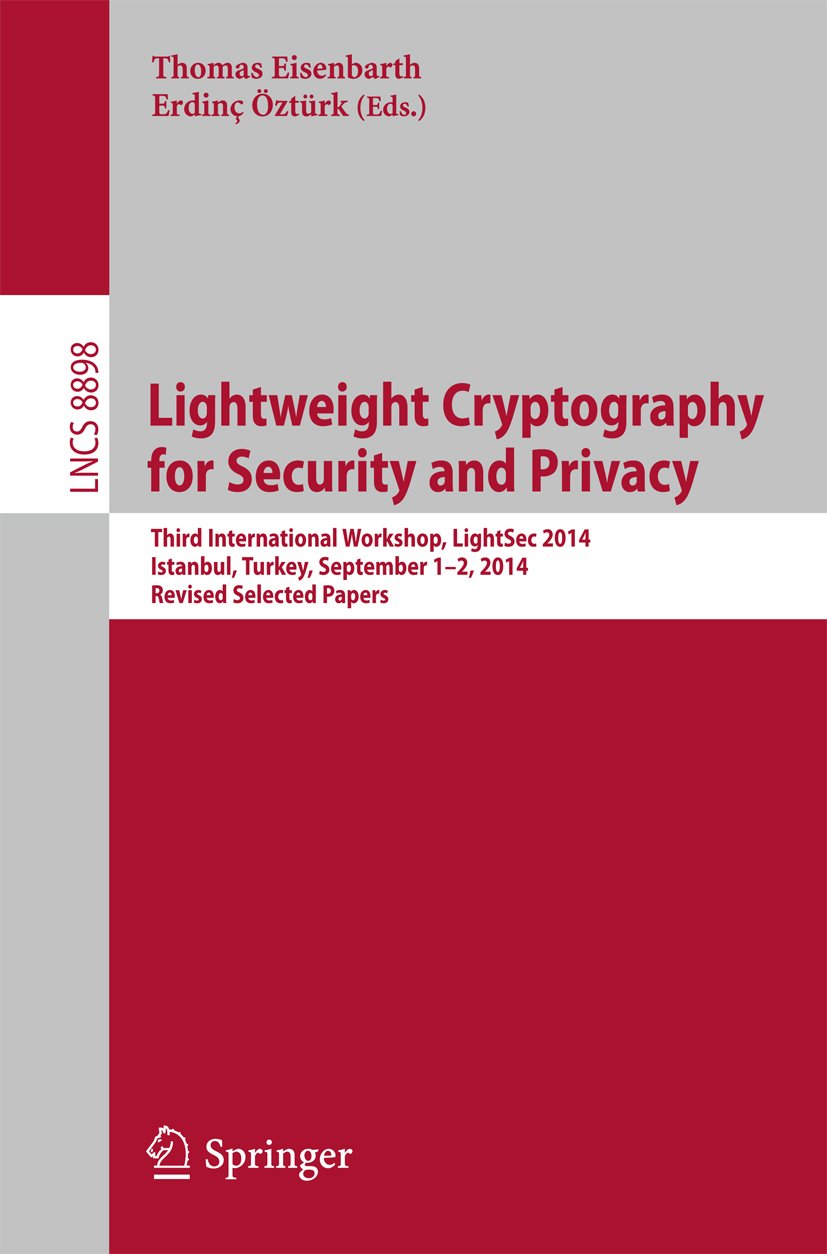
This book constitutes the refereed post-conference proceedings of the Third International Workshop on Lightweight Cryptography for Security and Privacy, LightSec 2014, held in Istanbul, Turkey, in September 2014. The 10 full papers presented were carefully reviewed and selected from 24 submissions. The papers are organized in the following topical sections: efficient implementations and designs; attacks; and protocols.

This book highlights recent research advances on biometrics using methods such as deep learning, nonlinear graph embedding, fuzzy approaches, and ensemble learning. Included are special biometric technologies related to privacy and security issues, such as cancellable biometrics and soft biometrics. The book also focuses on several emerging topics such as big data issues, internet of things, medical biometrics, healthcare, and robot-human interactions. The authors show how these applications have triggered a number of biometric approaches. They show, as an example, how fuzzy extractor has become a useful tool for key generation in biometric banking, and vein/heart rates from medical records can also be used to identify patients. The contributors cover the topics, their methods, and their applications in depth.

This two-volume set LNICST 335 and 336 constitutes the post-conference proceedings of the 16th International Conference on Security and Privacy in Communication Networks, SecureComm 2020, held in Washington, DC, USA, in October 2020. The conference was held virtually due to COVID-19 pandemic.
The 60 full papers were carefully reviewed and selected from 120 submissions. The papers focus on the latest scientific research results in security and privacy in wired, mobile, hybrid and ad hoc networks, in IoT technologies, in cyber-physical systems, in next-generation communication systems in web and systems security and in pervasive and ubiquitous computing.

This two-volume set LNICST 335 and 336 constitutes the post-conference proceedings of the 16th International Conference on Security and Privacy in Communication Networks, SecureComm 2020, held in Washington, DC, USA, in October 2020. The conference was held virtually due to COVID-19 pandemic.
The 60 full papers were carefully reviewed and selected from 120 submissions. The papers focus on the latest scientific research results in security and privacy in wired, mobile, hybrid and ad hoc networks, in IoT technologies, in cyber-physical systems, in next-generation communication systems in web and systems security and in pervasive and ubiquitous computing. 

Security has always been a pressing concern for computer users, especially those using Windows. Not that Windows is insecure by itself, but because Windows is the most widely used computer operating system, all hackers see it as their primary target. Also, unfortunately, many Windows users are not adequately educated in good security practices, and that makes them easy targets.

The other valid concern, that is specifically related to Windows 10, is user’s privacy. By default Windows 10 collects data from your direct use of Windows and all your Microsoft accounts.

Also, securing Internet browsers, messaging and email apps is vital to keep your system free of spyware and private.

This book teaches you, in easy terms, how to protect the security and privacy of Windows 10 and its apps. Also shows how to protect your anonymity and privacy on the web.

Some of the topics covered in this book are:

Basic Security Measures. The ABC of computer security.Basic Security Measures. The ABC of computer security.
Windows 10 Privacy Guide. Learn to configure Windows 10 to reduce Microsoft data slurp to the minimum.Windows 10 Privacy Guide. Learn to configure Windows 10 to reduce Microsoft data slurp to the minimum.
Computer Access Control. This explains how to secure your computer physically against hackers, how to encrypt it and how to secure computers used by several users.Computer Access Control. This explains how to secure your computer physically against hackers, how to encrypt it and how to secure computers used by several users.
Secure your Web Browser: Learn how to choose a web browser, how to configure it correctly and which extensions and add-ons are useful to protect better your security and privacy.Secure your Web Browser: Learn how to choose a web browser, how to configure it correctly and which extensions and add-ons are useful to protect better your security and privacy.
Tracking Techniques. By learning how you are tracked in the Internet, you can defend better against tracking.Tracking Techniques. By learning how you are tracked in the Internet, you can defend better against tracking.
Privacy and Anonymity. Learn how to use VPNs, the Tor browser and other techniques, to improve your privacy and surf the Internet anonymously.Privacy and Anonymity. Learn how to use VPNs, the Tor browser and other techniques, to improve your privacy and surf the Internet anonymously.
Security by compartmentalization. This is an advanced topic, but if you take the time to master it you will learn how to compartmentalize your computer using Virtual Machines, and in that way, make it impervious to ransomware and other common threats.Security by compartmentalization. This is an advanced topic, but if you take the time to master it you will learn how to compartmentalize your computer using Virtual Machines, and in that way, make it impervious to ransomware and other common threats.
Securing IOT devices. As cool as they look, IoT devices are a security nightmare. Learn how to secure them.Securing IOT devices. As cool as they look, IoT devices are a security nightmare. Learn how to secure them.

Plenty of other topics are covered in this book, look at its Table of Contents to see them all.

This book constitutes the refereed proceedings of the 17th International Conference on Trust, Privacy and Security in Digital Business, TrustBus 2020, held in Bratislava, Slovakia, in September 2020. The conference was held virtually due to the COVID-19 pandemic.
The 11 full and 4 short papers presented were carefully reviewed and selected from 28 submissions. The papers are organized in the following topical sections: blockchain, cloud security/hardware; economics/privacy; human aspects; privacy; privacy and machine learning; trust.

This book constitutes the thoroughly refereed post-conference proceedings of the 5th Annual Privacy Forum, APF 2017, held in Vienna, Austria, in June 2017. The 12 revised full papers were carefully selected from 41 submissions on the basis of significance, novelty, and scientific quality. These selected papers are organized in three different chapters corresponding to the conference sessions. The first chapter, “Data Protection Regulation”, discusses topics concerning big genetic data, a privacy-preserving European identity ecosystem, the right to be forgotten und the re-use of privacy risk analysis. The second chapter, “Neutralisation and Anonymization”, discusses neutralisation of threat actors, privacy by design data exchange between CSIRTs, differential privacy and database anonymization. Finally, the third chapter, “Privacy Policies in Practice”, discusses privacy by design, privacy scores, privacy data management in healthcare and trade-offs between privacy and utility.

This book constitutes the proceedings of the 7th International Conference on Future Data and Security Engineering, FDSE 2020, held in Quy Nhon, Vietnam, in November 2020.*The 29 full papers and 8 short were carefully reviewed and selected from 161 submissions. The selected papers are organized into the following topical headings: big data analytics and distributed systems; security and privacy engineering; industry 4.0 and smart city: data analytics and security; data analytics and healthcare systems; machine learning-based big data processing; emerging data management systems and applications; and short papers: security and data engineering.

* The conference was held virtually due to the COVID-19 pandemic.

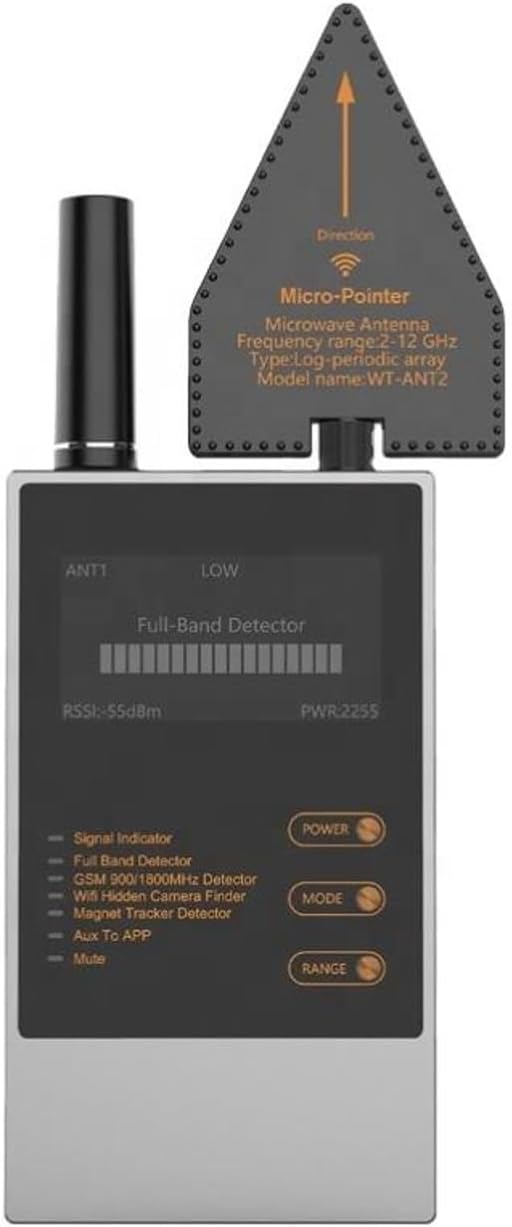
  • UNMATCHED RANGE DETECTION: 50MHz to 8GHz – Detects a wide range of digital and analog bugs, including hidden cameras, GPS trackers, and Trojan monitoring devices. Antenna 2 receiver covers 2400 MHz-2500 MHz.
  • ADVANCED AI TECHNOLOGY: Leverage cutting-edge AI to detect hidden cameras, GPS trackers, Trojan monitoring devices, and more, ensuring comprehensive privacy protection.
  • WIDE FREQUENCY DETECTION RANGE: Efficiently sweep frequencies from 50MHz to 8GHz to uncover a variety of surveillance threats.
  • HIGH SENSITIVITY AND DUAL SPEAKERS: Dual speakers enhance detection sensitivity, making it easier to locate even the most discreet surveillance devices.
  • USER-FRIENDLY DESIGN: Intuitive interface and compact design allow for easy operation by private investigators, law enforcement, and security professionals.
  • UNMATCHED PRIVACY PROTECTION: Ensure your privacy in an increasingly monitored world with this powerful and reliable bug sweep detector.
  • SOUND AND VISUAL LED INDICATORS: Dual-alert system with sound and visual indicators provides an immediate understanding of the threat type, enhancing your response effectiveness.
  • FOUR DETECTION MODES: Full Band Detector, Magnetic Signal Detection, WiFi Hidden Camera Finder, and GSM 900/1800MHz Detector for versatile and comprehensive detection.
  • Image editing program compatible with Windows 11, 10 (x64)
  • Create slideshows and photo collages
  • Adjust size, crop, rotate or straighten images
  • Optimize and enhance your photos
  • Burn photos to CD, DVD or Blu-ray
  • More than 200 photo features in total

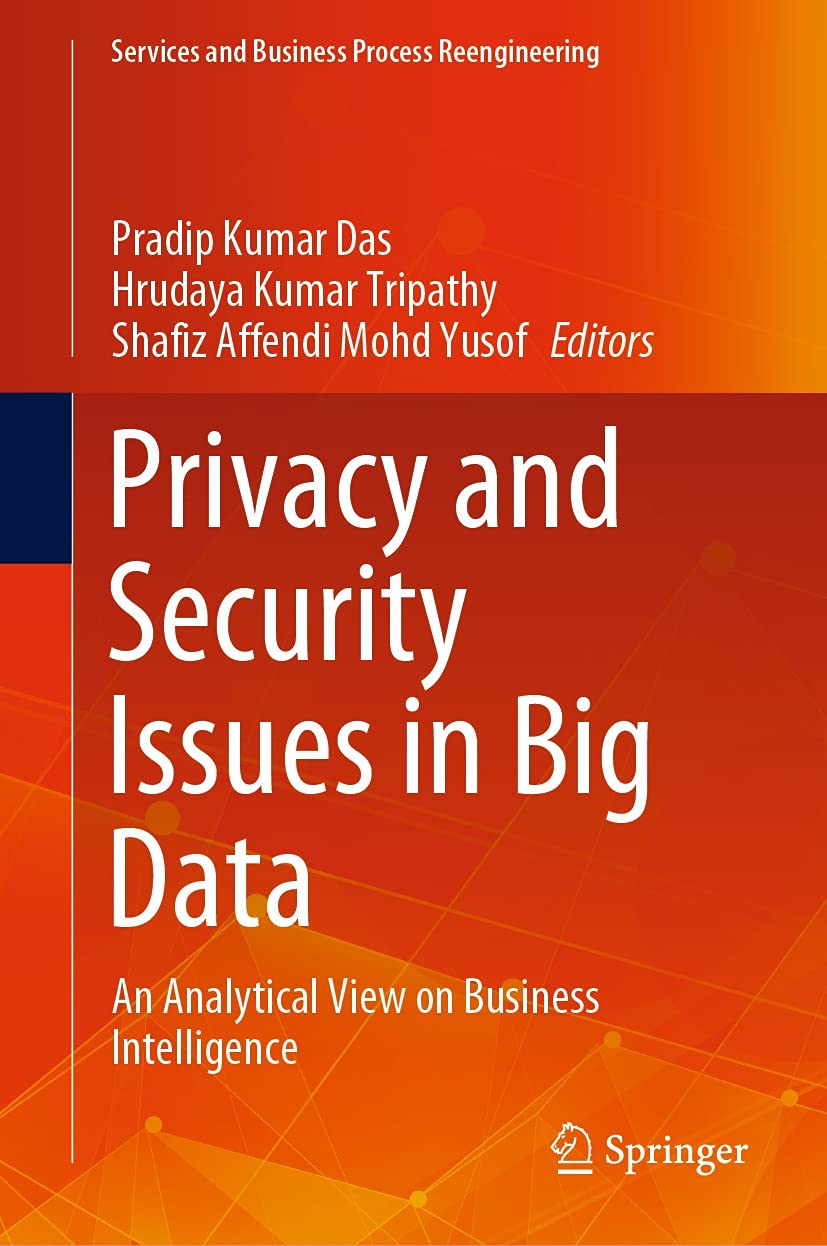
This book focuses on privacy and security concerns in big data and differentiates between privacy and security and privacy requirements in big data. It focuses on the results obtained after applying a systematic mapping study and implementation of security in the big data for utilizing in business under the establishment of “Business Intelligence”. The chapters start with the definition of big data, discussions why security is used in business infrastructure and how the security can be improved. In this book, some of the data security and data protection techniques are focused and it presents the challenges and suggestions to meet the requirements of computing, communication and storage capabilities for data mining and analytics applications with large aggregate data in business.

It is essential for an organization to know before involving themselves in cloud computing and big data, what are the key security requirements for applications and data processing. Big data and cloud computing are integrated together in practice. Cloud computing offers massive storage, high computation power, and distributed capability to support processing of big data. In such an integrated environment the security and privacy concerns involved in both technologies become combined.This book discusses these security and privacy issues in detail and provides necessary insights into cloud computing and big data integration. It will be useful in enhancing the body of knowledge concerning innovative technologies offered by the research community in the area of cloud computing and big data. Readers can get a better understanding of the basics of cloud computing, big data, and security mitigation techniques to deal with current challenges as well as future research opportunities.

This book constitutes the refereed proceedings of the 34th Annual IFIP WG 11.3 Conference on Data and Applications Security and Privacy, DBSec 2020, held in Regensburg, Germany, in June 2020.*

The 14 full papers and 8 short papers presented were carefully reviewed and selected from 39 submissions. The papers present high-quality original research from academia, industry, and government on theoretical and practical aspects of information security. They are organized in topical sections named network and cyber-physical systems security; information flow and access control; privacy-preserving computation; visualization and analytics for security; spatial systems and crowdsourcing security; and secure outsourcing and privacy.

*The conference was held virtually due to the COVID-19 pandemic.

This volume constitutes the refereed proceedings of six workshops held at the 9th International Conference on Security, Privacy and Anonymity in Computation, Communication and Storage, SpaCCS 2016, held in Zhangjiajie, China, in November 2016: the 7th International Workshop on Trust, Security and Privacy for Big Data, TrustData 2016; the 6th International Symposium on Trust, Security and Privacy for Emerging Applications, TSP 2016; the 4th International Workshop on Network Optimization and Performance Evaluation, NOPE 2016; the Second International Symposium on Dependability in Sensor, Cloud, and Big Data Systems and Applications, DependSys 2016; the Annual Big Data Security, Privacy and Trust Workshop, BigDataSPT 2016; and the First International Workshop on Cloud Storage Service and Computing, WCSSC 2016.
The 37 full papers presented were carefully reviewed and selected from 95 submissions. The papers deal with research findings, ideas andemerging trends in information security research and cover a broad range of topics in security, privacy and anonymity in computation, communication and storage.

Computer and network security is an issue that has been studied for many years. The Ware Report, which was published in 1970, pointed out the need for c- puter security and highlighted the di?culties in evaluating a system to determine if it provided the necessary security for particular applications. The Anderson Report, published in 1972, was the outcome of an Air Force Planning Study whose intent was to de?ne the research and development paths required to make secure computers a reality in the USAF. A major contribution of this report was the de?nition of the reference monitor concept, which led to security kernel architectures. In the mid to late 1970s a number of systems were designed and implemented using a security kernel architecture. These systems were mostly sponsored by the defense establishment and were not in wide use. Fast forwarding to more recent times, the advent of the world-wide web, inexp- sive workstations for the o?ce and home, and high-speed connections has made it possible for most people to be connected. This access has greatly bene?ted society allowing users to do their banking, shopping, and research on the Int- net. Most every business, government agency, and public institution has a public facing web page that can be accessed by anyone anywhere on the Internet. – fortunately, society’s increased dependency on networked software systems has also given easy access to the attackers, and the number of attacks is steadily increasing.

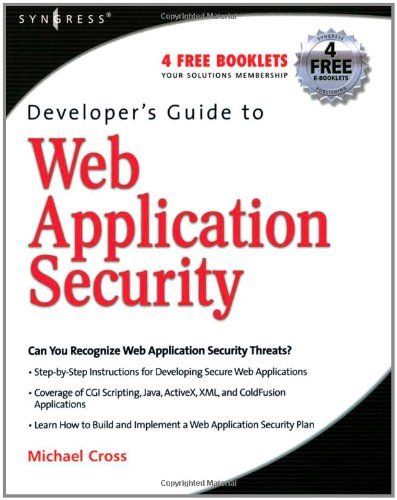
Over 75% of network attacks are targeted at the web application layer. This book provides explicit hacks, tutorials, penetration tests, and step-by-step demonstrations for security professionals and Web application developers to defend their most vulnerable applications.

This book defines Web application security, why it should be addressed earlier in the lifecycle in development and quality assurance, and how it differs from other types of Internet security. Additionally, the book examines the procedures and technologies that are essential to developing, penetration testing and releasing a secure Web application. Through a review of recent Web application breaches, the book will expose the prolific methods hackers use to execute Web attacks using common vulnerabilities such as SQL Injection, Cross-Site Scripting and Buffer Overflows in the application layer. By taking an in-depth look at the techniques hackers use to exploit Web applications, readers will be better equipped to protect confidential.The Yankee Group estimates the market for Web application-security products and services will grow to $1.74 billion by 2007 from $140 million in 2002 The Yankee Group estimates the market for Web application-security products and services will grow to $1.74 billion by 2007 from $140 million in 2002 Author Michael Cross is a highly sought after speaker who regularly delivers Web Application presentations at leading conferences including: Black Hat, TechnoSecurity, CanSec West, Shmoo Con, Information Security, RSA Conferences, and more Author Michael Cross is a highly sought after speaker who regularly delivers Web Application presentations at leading conferences including: Black Hat, TechnoSecurity, CanSec West, Shmoo Con, Information Security, RSA Conferences, and more

How to get cashback?

3 Easy Steps
Register on Our site
This is only 1 Minute
Choose Offer and buy it
You will get cashback points once
we approve your purchase
Request money
Go to your profile and click on
request button
TOP CASHBACK
DEALS AND COUPONS

TOP Shops

Gogreen
Up to 15% for cashback and deals
Gogreen
6 Offers
Up to 15% for cashback and deals
Everydoo
Logo
Compare items
  • Total (0)
Compare
0
Shopping cart